Ridgewood - a St.Louis Mid Century Modern Neighborhood

Promoting the preservation of Mid Century Modern residential architecture in St. Louis through education, appreciation and awareness.

Saturday, November 14, 2009

Design is the Pay-Off

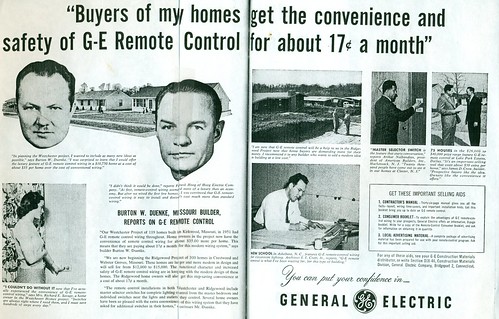
House + Home magazine got it right back in February of 1953, when stating "Builder Burton Duenke learns by happy experience that people want better houses. Even in conservative St. Louis, buyers scramble for fresh design he and his architect developed."

With this post we want to share some of the thoughts, explorations, and fabrication details that went into building the individual homes of our neighborhood. The following are excerpts from the February 1953 House + Home article detailing Ridgewood and it's construction.


"After footings are poured, a factory built center section is erected on a center grade beam. Skeleton is then plumbed and braced. Beams are marked at the factory to indicate where rafters are to be placed. End rafters are butted, others overlap. Factory made spacers between rafters have holes pre-drilled in them to ventilate space between roof and ceiling. Screen is stapled over the holes. Tar-and-gravel roof is built-up, followed by panels. Construction of panels is shown below."
"Time and labor on the job are cut by building panels in jigs. Each jig is on an 8" sq. table at convenient work height. Panels are built up in layers: studs, sheathing, V-Joint redwood siding applied without turning panels over."

Given the current interest in green building, LEED, and pre-fabricated housing, it is refreshing to read that a home builder 50 years ago was fully vested in developing economies in the construction process.

House + Home continues with:
"Duenke uses post-and-beam plus prefab panels."
Duenke's building methods are probably unique in his area. He carries post-and-beam construction one logical step further than is customary by using prefabricated panels between post 6'-4" o.c. He pours his slab floor after his side walls are up and his roof is on.

His unconventional techniques came only after he had tried other methods. He has grown (from six houses in '46 to over 200 in '52) because he tries any new techniques in the field. He tried roof trusses, gave up on them because he believed they took too much material, were too cumbersome to handle. He built 24' side walls in one piece, gave them up because he had to stop his union carpenters on their job and get them to haul the long panels off the truck and into place. He refected 4' prefab panels because they required too much labor on the job to put together. The 6'-4" panel he finally selected as the most economical was based on the allowable roof span required by the F.H.A. Thus 6'-4" became his module."

"Redwood panels, above, are fitted to post-and-beam skeleton by two men using simple lever tools. A tolerance of 1-1/2" is allowed in panel frames so they can be adjusted and plumbed between posts. Extra-long lap or groove at ends hides panel joints."


"Panels shipped with glazed windows:
The vertical redwood panels are made in a plant he bought 2 years ago. The mill is several miles from his present site but will be closer to his next development. Duenke says, 'we can put sheathing and exterior siding on in the same time it takes to apply sheathing alone in the field.' Aluminum windows are calked and glazed in the panels; but big window walls are site glazed. A portion of every glass area has screened, sliding sash for ventilation. Door frames are weatherstripped and hardware installed in door frames; doors are fitted to the panels."

"Exterior can be varied
The prefab panel allows tremendous flexibility of exterior: the homebuyer can have solid panels, window walls or high strip windows almost any place he wants them. This flexibility allows the home owner to take advantage of sun, view and breeze. Over a dozen shifts can be made in the basic three-bedroom-and-carport pattern on which Duenke concentrated in his Ridgewood development (233 of 258 houses) : the carport can be put in any one of four places; the fireplace can also be placed in several locations."


"Non-loadbearing partitions are precut and assembled before delivery to the job. Since they can be stored under roof until ready for use, there is no time lost waiting for arrival of materials, no cutting of small pieces. Insulation is applied with staple gun before dry walling."


We will continue to discuss and promote the virtues explored and carried out by builder Burton Duenke and architect Ralph Fournier with their Ridgewood neighborhood more than 50 years ago in future posts. Meanwhile, we are interested in your opinions on the current trend of a "greener", more economical, sustainable lifestyle and how this relates to the post-war built environment of the 1950's.

Tuesday, June 2, 2009

Spreading The Word

We have plans in the month of June to distribute an informational flier to all of our Ridgewood neighbors (see a preview of the flier below). It will serve as a point of contact for anyone who may not already be familiar with the blog, in hopes of gaining more neighborhood information. In addition, we hope to meet some new faces while spreading info on neighborhood appreciation and preservation.

We hope to get a few volunteers to help with our effort. We have set up an official Ridgewood email ridgewoodstl@gmail.com, and sending a message to this address will add you to our contact list. For any neighbors who have previously commented on the blog, we encourage you to send an email as well.

Once we begin to receive emails from those interested, we will plan a time to meet prior to the day fliers are distributed. This will give us a chance to share information and finalize our preparations. We hope to hear from you!

Monday, May 11, 2009

Ridgewood In The News

Recently, we were contacted by a writer for the St. Louis Post Dispatch who expressed interest in writing an article featuring our Ridgewood home.

The article, Preserving '50s Ranch Style, appeared in the May 9th Life & Style section and includes a slideshow of additional images.

Wednesday, March 25, 2009

update, Ridgewood 2009

We are in the process of setting up a more permanent website for the neighborhood. The site will include history, photos, a calendar for events, and the continuation of this blog. Meanwhile here are examples of two homes in the neighborhood today.


exterior


living room, front entry


living room


living room


bedroom


bedroom


enclosed carport now living room


exterior


Wednesday, November 26, 2008

A Look Into Five Star Home No. 2301

Upon completing the Ridgewood project, Burton Duenke realized the appeal of presenting the homes to Better Homes and Gardens readers through their Five Star Home program.

In "An Acheivement in Small House Planning," Better Homes and Gardens accurately describes the Ridgewood home in its January, 1953 issue. As demonstrated in an ongoing showcase of featured homes, the Ridgewood house was offered as "Five Star Home No. 2301."

The Five Star home program was a way for Better Homes and Gardens to provide anyone access to quality home plans at a cost of only $5, and a way for builders to promote their homes to a broader audience. This program also allowed Better Homes and Gardens to present the best aspects of a home's appeal regardless of style. This was especially important when featuring a "modern" home as early as 1953 since some buyers were less familiar with the benefits of living in such spaces.

Photographs used in the article were taken of the house at 1739 Ridgewood Dr. The introduction to the Ridgewood home, written by John Normile, AIA (American Institute of Architects) for Better Homes and Gardens accurately describes the home as follows:

"Here's a house that packs a lot of living into just 1,168 square feet of floor space. Selected as Five Star Home No. 2301, the three-bedroom scheme is developed within the rigid limits of an economical rectangle that's only 26X51 feet in size. It reflects to a high degree the sound planning ideas usually employed in more elaborate houses.
Does the term "modern planning" apply to this house? Definitely. Very simply, it shows up in the allocation of space according to use; in openness developed through use of glass, sloped ceilings, and lack of partitions; in a smooth indoor-outdoor transition.

Though this house has fewer square feet than many two-bedroom houses you'll find, it has three bedrooms. For the family that needs only two bedrooms, the smallest can become a study-guest room. The six closets are prefabricated units that double as partitions. Each has sliding doors, plus a shelf above. The largest bedroom has a built-in dressing table with large mirror and recessed light.

Each bedroom has nearly equal access to the bathroom. Linen is stored in a closet just inside the bathroom door, only a few steps from linen-using areas. Another stepsaver is the built-in hamper opening into the hallway. soiled clothing and linen go into this hamper that's only an arm's reach from the washer.
All three bedrooms have high strip windows along one wall, allowing free arrangement of furniture without cutting out light and air. In addition, they insure privacy from next-door neighbors.

This house develops a pleasing feeling of spaciousness considering its limited size, through the use of glass and space. Large windows give a light, airy feeling lacking in many houses half again as large.
Floor-to-ceiling windows in both living room and parents' bedroom add visual "space" that you don't get with smaller openings. Except in the hallway, all ceilings follow the roof line.

At least a portion of every glass area includes screened sliding sash for ventilation. All movable glass is removable, too, for easy washing in the sink.

Furthering the openess is the elimination of partitions in the living-dining-kitchen area. Here, the dining room becomes an extension of the living area, and the kitchen is open, too, except for a well-placed, partial partition.

The smooth transition from indoors to outdoors is furthered by the large windows. And with the entrance under the carport, you're only a few steps from the terrace. If you don't mind letting the car get wet on rainy days, the carport is useful as a fresh-air rumpus place for the kids.

The low-pitched gable roof gives the house drama and a feeling of stability. The long roof extensions, which shelters the inexpensive carport and bulk storage space, gives the house extra width; it serves as an important design variation from the basic rectangle of the house itself.

A touch of luxury is found in the handsome stone fireplace. But it adds so much warmth and friendliness to the living room, and gives such good balance and texture to the exterior, that it becomes almost a necessity. Five Star Home No. 2301 has wonderful flexibility. It will serve the needs of families numbering from two to five. Its architecture is contemporary, yet moderate enough to fit comfortably into almost any neighborhood."

Burton Duenke would later comment on the success of the Five Star program and its ability to draw visitors and buyers, within the St. Louis area and beyond.

Though written as a description of the Ridgewood homes when new in the early 50's, it is just as easy to imagine John Normile submitting this article for any number of contemporary publications today. The Ridgewood home remains a design that maximizes quality of space, has an open plan that is liveable, and maintains a unique style of living still relevant for today.


Friday, November 14, 2008

Welcome


 Five Star Homes No. 2301" Better Homes and Gardens, January 1953
"Oh, you live in one of them houses with the funky windows on the front?" This question typically comes after you tell someone you live in Ridgewood, a small neighborhood located in Crestwood, a suburb of St. Louis, MO. Hopefully this blog will enable an informed rebuttal to this often asked question.

 
The Ridgewood subdivision, located in Crestwood, Missouri, is a neighborhood of 258 modern ranch homes built in the early 1950's. To meet the public's growing demand for modern homes, successful St. Louis Developer Burton Duenke, in collaboration with architect Ralph Fournier, conceived Rigewood as a modern alternative to the traditional style homes Duenke had been building since 1946.

 "Five Star Homes No. 2301" Better Homes and Gardens, January 1953
The Ridgewood concept was an immediate success, and popular publications of the time such as Better Homes & Gardens and House + Home magazine were quick to showcase Ridgewood homes in their feature articles. Unique both for the time and for St. Louis, the Ridgewood project was also advanced in its form of construction. Duenke founded his Modular Homes company to create a unique, partially prefabricated building method that would further the success of his project. Post and beam frame construction, combined with an innovative modular panel system allowed the Ridgewood home to be affordable, practical, and approachable. The modular panel system was successful enough to allow the Ridgewood home to be built in numerous locations within a 500 mile radius of St. Louis.

"Five Star Homes No. 2301" Better Homes and Gardens, January 1953
At the time the Ridgewood development began, other builders across the country were working to fill a similar void in the housing market. In California, builders such as Joseph Eichler sought to provide the ultimate in living the "California Lifestyle" with his tract homes. Similarly, Cliff May began developing his own modular home program using techniques similar to those utilized in Ridgewood. In cities like Tulsa, Oklahoma, Lortondale became one of the first large scale housing developments to incorporate features such as slab-on-grade construction and central air conditioning. The Ridgewood project allowed St. Louis homeowners to experience living in a home with features similar to these, while enjoying a modular, partially prefabricated home that was entirely unique.

In future posts, this blog will serve to share the history and information gathered about Ridgewood after much research. It is hoped that it will provide a valuable resource to fellow residents who share a common interest, as well as help establish an increased sense of community. In addition, a broader scope of mid century residential architecture in St. Louis will be explored and included. Throughout the progression of this blog, any information, images, or resources you wish to share on Ridgewood or other homes/neighborhoods is welcomed and appreciated.